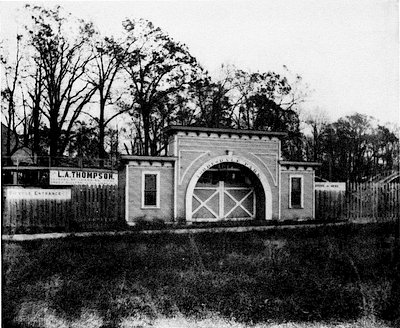
Amusement Park at Frankford Avenue and Poquessing Creek. 1880
to 1906.
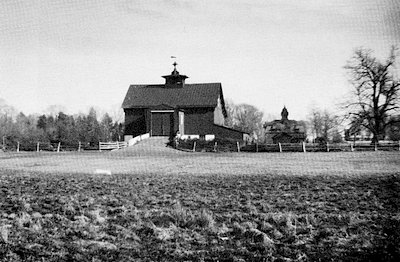
Nelson Brown's Barn. State Road and Convent Lane, 1946.
Photo courtesy of Bernard Stiffel.
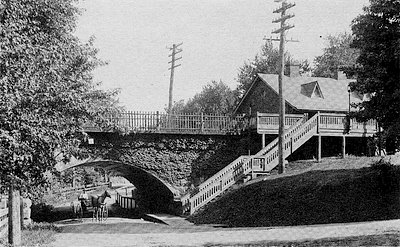
Torresdale Railroad Station at Grant Avenue and James Street.
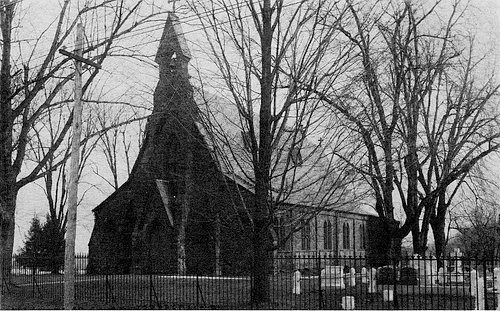
All Saints Church at Frankford Avenue south of Grant Avenue. Photo
courtesy of Elaine Malinowski.
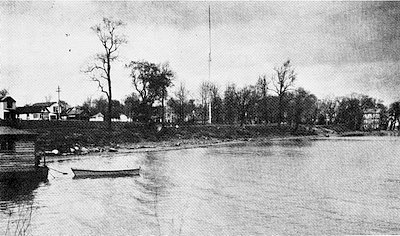
Delaware River at Delaware Avenue and Linden Avenue, 1920. Photo
courtesy of William English.
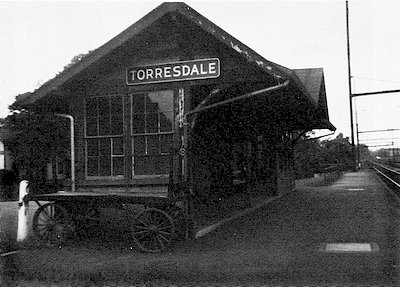
Torresdale Railroad Station. Photo - 1946. Photo
courtesy of Bernard Stiffel.
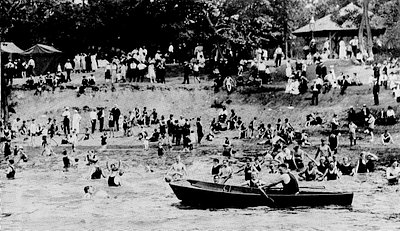
Pleasant Hill Beach, a Sunday afternoon August 8, 1921.
During the summer season, Pleasant Hill was an early recreation area
in Northeast Philadelphia. Today it is the Linden Avenue boat
launching area. Photo courtesy Urban Archives, Temple
University
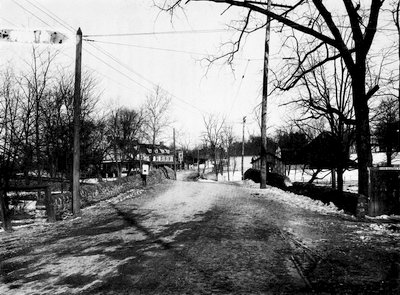
Frankford Avenue (Bristol Pike) at City Line. Note the Red
Lion Inn. Roadway and bridge were rebuilt in 1904. Photo -
1902.
|
The name Torresdale comes from Torrisdale, the ancestral
Scottish home of Charles Macalester, the man who originally owned the
land now in use by Glen Foerd Mansion. In 1850, Macalaster bought this
land and had a small summer home built on it. An important figure in
American History, Macalaster was a banker and a diplomat with a home
in Washington, D.C. (which is now the Russian Embassy) and an elder in
the Presbyterian Church. He had a home in downtown Philadelphia at
10thand Spruce Streets. His daughter, Lily, was a debutante who lived
for the most part in Europe close to Paris. Macalester was involved
with Biddle in the Second Bank of the United States located at 2nd and
Chestnut Streets which lost its charter because President Andrew
Jackson felt that banks had too much influence in the country. Located
at the Torresdale Train Station and Grant Avenue was the estate of
Captain Barry. In 1847 the Sisters of the Sacred Heart, based at Logan
Circle, purchased this40 acres which is now known as Eden Hall. They
planned a boarding school for Catholic girls of wealthy backgrounds;
instead, they built a European-style chapel which still stands. The
Sisters� had many diplomats� daughters and actors� daughters
(Boris Karloffs and Basil Rathbone�s to name a few). Their alumni
are loyal to this day. Thearea has been renamed Fluehr Park in honor
of Joseph Fluehr, Poquessing Real Estate�s founder, in the hope that
the ground would not be sold to developers. The land was
�dedicated� with the intentions that Fairmount Park very seldom
lets �dedicated� land be sold. The Friends of Fluehr Park have
$32,000 in their treasury and hope to start repairs to the Chapel
soon.
An addition to the chapel was built at the turn of the century
when Elizabeth Drexel (the eldest of the three Drexel girls), added a
crypt to the North side of the chapel with a room called the �Lady
Chapel on top of the Crypt.� In the crypt she planned to inter her
family and other loved ones. She buried her mother, Emma Bouvier
Drexel, her father, Francis Drexel, her own child, a girl who was
stillborn and Helen Grace Smith, her husband�s sister. Elizabeth�s
husband was the son of Kirby Smith, a Civil War General who lived at
the now famous Smith-Wallace house at Milnor and Fitler Streets.
Francis Drexel�s summer home can be found where the new
Frankford Hospital now stands. The original home still stands near the
Emergency Room. There was a chapel also built by Louise Drexel (the
youngest). It is known as the Chapel of the True Cross, which was used
to house the Drexel Family for a time. In the Drexel�s townhome at
15th and Walnut Streets, Emma opened her home to the poor on a weekly
basis. Sheave food, clothing, and shoes. They were a very religious
and generous family.
Jacqueline Kennedy Onassis was a Bouvier, which was Drexel�s
wife�s family. She is linked with the Sacred Heart Chapel through
her father�s ancestry. When she went to the White House she took the
Bouvier chairs with her which she was invited to take from the chapel.
Her great-grandfather Bouvier was a carver of chairs. Saint Katherine
of Siena Church, 9600 Frankford Avenue, originally was located on Eden
Hall grounds. The small school was set up by the Sacred Heart nuns to
accommodate the children of the neighborhood whose parents wanted
their children to have an education equal to the boarding school. Eden
Hall�s property extends all the way back to the rear of All
Saints� Episcopal property.
All Saints� Episcopal church is one of the oldest churches in
Philadelphia and is the mother church of the Church of the Redeemer in
Andulusia. �All Saints� is noted for its eight (8) Tiffany
windows, it�s lovely architecture and its beautiful bells which can
be heard at lunch time everyday. In its little churchyard are buried
some of the most prominent people in this area, such as Risdon who
started the Morelton Inn, the Washington House and other hotel-type
accommodations.
The Morelton Inn, between Glen Foerd and Baker�s Bay was a
wonderful vacation place in the 1890�s. Many of the wealthy
residents came from town to escape the summer heat and the intolerable
fumes of the city. This entire area became enveloped by homes used as
gambling casinos and rental homes and was soon considered a resort
area. Macalester in 1850 became an entrepreneur in real estate as this
area was adjacent to his Glen Foerd property (then known as Glen
Garry). Macalester had a church built, one on Grant Avenue. The
Macalester Church on Grant Avenue was razed and a new church was built
at West Crown and Morrell Avenue at a later date.
The Torresdale Country Club was founded in 1898, with an
appendage of the club located at Oxford Avenue and Harrison Street
(the old Wistar Farm). A decision wasmade to move the club to
Torresdale, at the present location of Frankford High School. The old
area of the club included from an early time, a nine-hole golf course.
Colonel Edward Deveaux Morrell (1863- 1917) owned extensive
land in Torres-dale. Not only did he own the land on which the
Morelton Inn was located (Virginia Knauer�s property), but he owned
land in the vicinity of Frankford and Morrell Avenues as well. Morrell
came from a family of Quakers who owned a home known as the Powell
House on 2nd and Pine Streets. Morrell was a lawyer by profession and
earned his title� Colonel� through his association with the First
City Troop, an Elitist Calvary Troop that could be seen at most
Thanksgiving Day Parades in Philadelphia. He married Louise Drexel,
and they maintained one of their five homes at Morrell Avenue and
Frankford Avenue near Louise�s father�s family home. Colonel
Morrell entertained military men on his grounds, had a horse track,
and an amusement park for children and adults in the vicinity.
�Torresdale Park� as it was called was located in back of the
trolley car barn at Frankford Avenue and Knights Road. Torresdale Park
donated many of its rides toWillow Grove Park after closing.
The area between Grant Avenue and Fitler Streets and between
State Road and the River is full of history. Called Resort Town at the
turn of the century, some of the homes were casinos and fancy boarding
houses. These include the remnant of the Morelton Inn, the Delaware
River�s famous spot reached by steamboat and later by railroad. To
the north of Glen Garry in Andalusia, sits the Biddle Estate once
visited by French aristocracy (Joseph Bonaparte). Bonaparte lived in
Bordentown, but visited Andalusia regularly where he was the guest of
Nickolas Biddle, the man who began the Second Bank of the United
States and who opposed President Andrew Jackson�s efforts to close
private banks. James Biddle lives in Andalusia now and occasionally
has tours on his property of the home his parents built. The home
resembles a small Doric Temple and faces the river. The rest of the
property is reminiscent of a plantation with an 18thcentury flavor. It
is well worth a visit. Mr. Biddle�s ancestry is inscribed throughout
Torresdale.
In the late 1500�s, English, Dutch, and Swedish adventurers
explored the Atlantic sea coast south of Manhattan. A Dutch captain,
Cornelis Hendrickson, explored the South River (Delaware) in 1616.
Shortly after settlers arrived, forts and trading posts were
established along the river. A Lenape Indian village existed in the
area near the Delaware River and the Peetquesink Creek (Poquessing).
This area consisted of 670acres of land which was granted to Olle
Coeckal and Lars Larson. They were joined by others who had settled in
the same area. The riverfront became known as Swedeland. As time
passed, the ownership of this land changed many times.
Besides Charles Macalester�s magnificent home, Glen Garry,
Torresdale had many other fine estates. Before Macalester arrived,
Evan Thomas owned land in the area. He built a bakery on his property
to supply the cargo ships that docked at his wharf. When General
Washington�s troops arrived during the American Revolution, Thomas
baked bread for the army. Thomas�s property was known as the Bake
House. La Carolina was a splendid mansion overlooking the river, owned
by William Hood Stewart. He built his house on land purchased from
Mrs. Thomas Morgan, the owner of the vast Bake House property. George
Carson also purchased a tract of the Bake House land and built a
beautiful mansion, which he called the Rose Cottage. Vancouver was
another grand estate. It was destroyed by fire sometime in the
1900�s. Baker�s Bay condominium complex is now located on this
property.
Before Macalester built Glen Garry, he lived at Risdon Tavern.
Since the area was excellent for hunting and fishing, visitors came
from Philadelphia by steamboat to Risdon�s. When Macalester
purchased the land he called Torresdale, the tavern was included. It
was later sold to Edward M. Hopkins who built the Morelton Inn. The
Inn became so popular with affluent Philadelphians that other
buildings had to be built to house and entertain the guests. The main
building, The Inn, was a fine mansion, which stands today overlooking
the river at the foot of Filter Street. A second building, TheAnnex,
now serves as the home of the Delaware River Yacht Club. The third
building, The Casino, is now a private home at the southwest corner of
Grant Avenue and Wissinoming Street.
San Michael was a sprawling farm purchased by John R. Wilmer,
who rebuilt and enlarged the house. The property later was sold to the
Drexel Family. The Drexels built a chapel on the land, now part of the
Frankford Hospital Complex, from Knight�s Road. The Beechwood, later
known as San Jose, was another of Torresdale�s grand estates. The
mansion was built about 1850. Colonel Morrell purchased the property
consisting of 143 acres, but after he purchased adjoining properties,
Beechwood�s land totaled 300acres. The estate stood near Red Lion
Road and the Bristol Turnpike (Frankford Avenue). It bordered three
old townships, Moreland, Byberry, and Delaware. In 1854when the county
of Philadelphia and the City of Philadelphia became one, the boroughs,
districts and townships that were separate municipal entities were
brought together.
Just a short distance west of the King�s Highway (Frankford
Avenue) on Red Lion Road, Dr. Benjamin Rush was born. Torresdale was
home to many prominent Philadelphians and is rich in history. We can
only touch on a few. We urge everyone to read the books titled Lights
along the Delaware and Bristol Pike.
Interviews...
The
interviews were done by Traci Berardi and Kelly Donahue from the
Nazareth Academy High School.
Ken Rossbauer has lived in the Torresdale area for sixty-five
years. He is the current owner of Torresdale Fuel Company (formerly
Torresdale Coal Company). The coal company was started in 1841 by the
Thomas family, who operated it until the early1900s. The company was
sold a few times, then in 1941 Rossbauer�s father purchased it.
Rossbauer delivered coal to most of the homes in the area. They
had one truck, a 1929 open cab Autocar, top speed 25 m.p.h. Rossbauer
was awed by the fine mansions he served, Glen Foerd, Marlton Inn, Rose
Cottage, and many others. As he looks in the past, he said the area
was peaceful and the people were friendly. He said he still loves
Torresdale.
Ralph Recupido lived in the area almost eighty years. His
father lit the gas operated lamps in the area. He helped his father
clean and maintain the lamps. He also told us the Torresdale Country
Club property was a nine-hole golf course near Grant Avenue on Academy
Road.
The school board of Philadelphia purchased the Frankford
Country Club property to build the Frankford High School. The two
clubs merged to form the Torresdale-Frankford Country Club at Grant
and Frankford Avenue. He told us that the work on the course was done
by hand.
Florance Snecket lived on Frankford Avenue for many years. She
remembers the Blacksmith shop on the corner on Linden and Frankford
Avenues. She watched the Blacksmith shoe horses and repair or make new
tools for the area farmers.
Herman Steiner enjoyed Pleasant Hill Beach as a young boy. His
family would picnic there on Sundays. He said he was going to live in
Torresdale someday because it was so �country.� In 1931 he
purchased a lot and built a home.
Preston Smith has been a Torresdale resident for over sixty
years. He loves the outdoors. He camped along the river most summer
nights. He worked on many of the estates along the Delaware River. In
the late thirties and early forties, he found a few arrow heads along
the creek. He loves Torresdale. He remembers the winters as being
colder with more snow. Some of the residents had horse drawn sleds for
winter night rides and hay wagon for summer evening hay rides.
Fred Yeagle lives on the 9600 block of Frankford Avenue. He has
been there for fifty-eight years. He lived in Holmesburg for twenty
years. He remembers the trolleycars running along side of the Avenue.
When the trolleys would get stranded in snowdrifts, his mother would
give the motorman and his passengers hot tea or coffee. The men and
boys would then pitch in and help dig out the stalled trolleys.
We talked with William Brinkman, who worked for the
Pennsylvania Fish Commission. He told us that the state hatcheries
were located in Bristol, Pennsylvama. In the early 1900�s the
hatcheries were moved to Torresdale at Linden and Delaware Avenues.
The young fish (fry) were placed in milk containers and loaded on
horse drawn wagons and hauled to the Torresdale Station to be shipped
around the state. In 1956,the city of Philadelphia took over the
hatchery property. It is now part of the Department of Recreation.
William English is a long time resident of Torresdale. He
remembers the sleds and horse drawn wagons. He also recalls playing in
the empty mansions. There were plenty of farms in the area. The
farmers would place full milk cans on State Road so the dairies could
process the milk.
The children in the area attended the Torresdale School, a one
room building on James Street near Fitler Street. The Maple Grove
School was another school that local children attended. It is now a
private home at Academy and Red Lion Roads.
Frankford Avenue was first called King�s Highway. Stage coach
lines traveled over the highway from Philadelphia to New York. The
trip took two to three days. Frankford Avenue was confirmed from Front
and Vine Streets to the Poquessing Creek in 1747. It became part of
the Frankford Bristol Turnpike System. The turnpike came into
existence in the early 1800�s. A toll house stood at the bridge near
the Pennypack Creek. The road was free of tolls in 1892.
Grant Avenue, some (falsely) believe, was named for Ulysses S.
Grant. More likely it was Samuel Grant, who purchased land in the area
from the Macalesters. Convent Lane was a dirt path from the King�s
Highway to The Bake House property on the Delaware River. It also
bordered the Eden Hall property for which it was named. The book
titled Bristol Pike refers to Convent Lane as Eleven Mile Lane. It was
so named because it was located eleven miles from Second and Market
Streets. Old maps show Linden Avenue as Eleven Mile Lane.
All Saints Episcopal Church on Frankford Avenue near Grant
Avenue was built in 1773. It served as a meeting place as well as a
house of worship for the early settlers.
|